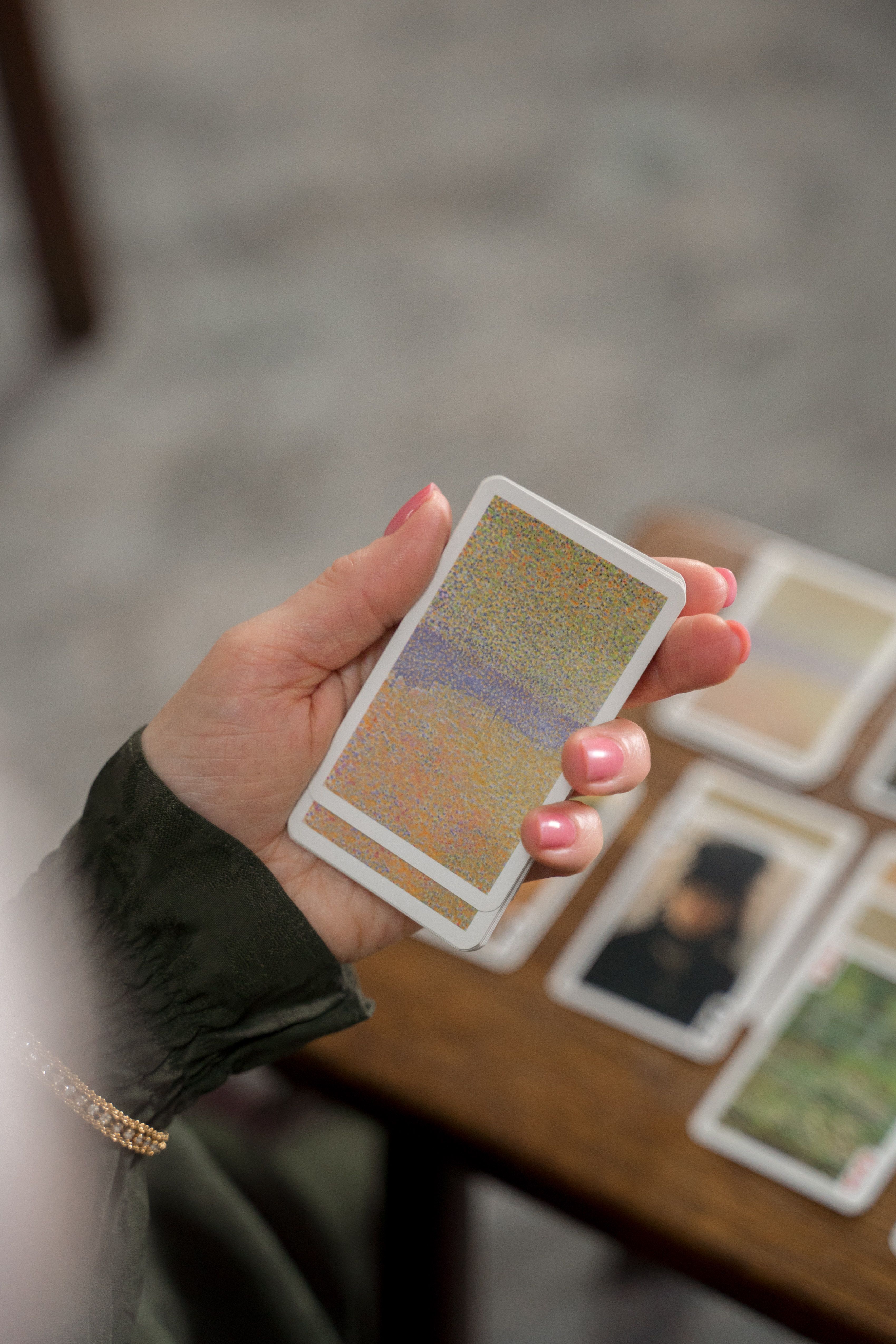
Metaphoric associative cards (MACs), also known as projective or therapeutic cards, are one of the most versatile tools in contemporary psychotherapeutic practice. They are decks of images — sometimes accompanied by words — that carry no fixed meaning. This is precisely where their power lies: each person projects their own thoughts, feelings, and experiences onto the card, without feeling the pressure of giving the "right" answer.
How Metaphoric Cards Work
The mechanism behind MACs rests on psychological projection — a process in which unconscious content is transferred onto a neutral external stimulus. When a client looks at a card with an ambiguous image and is asked "What do you see?" or "What does this remind you of?", they unconsciously select details that resonate with their personal situation.
Because the cards have no "correct" interpretation, the resistance typically triggered by direct questions is significantly reduced. People who find it difficult to speak directly about painful subjects discover that they can talk "about the card," when in fact they are talking about themselves. This creates a psychological distance that makes difficult material more bearable and accessible for exploration.
MACs are not a "fortune-telling" tool — they are a carefully structured method for accessing a person's inner world through the language of images.
What Problems They Are Used For
Anxiety and stress
The cards help clients visualize and "externalize" an unidentified, hard-to-name unease, giving it a concrete form that can be worked with.
Processing loss and trauma
For subjects too painful to verbalize directly, the card serves as a buffer, allowing a gradual approach to the material at the client's own pace.
Relationships and family communication
The cards reveal differences in how each family member perceives the same situation, opening up a space for dialogue that is often blocked in direct conversation.
Self-knowledge and decision-making
During a crisis of choice or a period of transition, the cards help clarify conflicting desires and values that would otherwise remain unconscious.
Work with children and adolescents
Because the method is image-based and playful, it is especially well suited to younger clients, for whom abstract verbal conversation is more difficult.

Why They Help People
They bypass rational censorship. When we speak directly about ourselves, the inner critic often edits the response according to the other person's expectations. Projection onto a card temporarily lulls this defense.
They activate the right hemisphere and image-based thinking, granting access to emotional and sensory material that is difficult to capture in words alone. Many clients discover nuances of their experience only once they see them reflected in an image they themselves have chosen.
The cards restore a sense of control. The client decides for themselves what to share and at what pace — something especially important for people who have experienced a loss of control following trauma.
Finally, the method can be woven into almost any stage of the therapeutic process: from establishing contact, through deepening the topic, to closing the session and summarizing.
In Conclusion
Metaphoric associative cards are not a "fortune-telling" tool, but a carefully structured method for accessing a person's inner world through the language of images. Their value lies not in the images themselves, but in the conversation they make possible — a conversation that often remains out of reach until the right bridge between the conscious and the unconscious is found.
Would you like to learn more or experience working with MAC cards? Book a consultation.
Book a consultation